

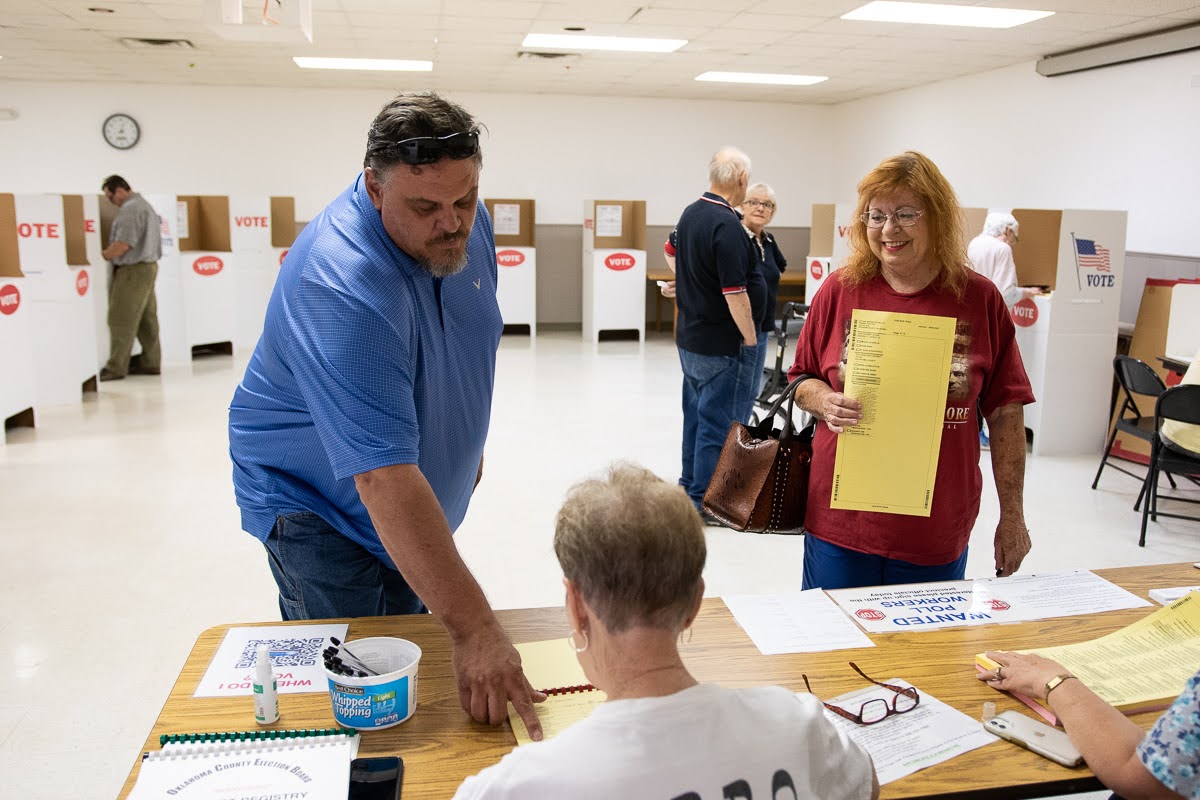
For the first time in a decade, registered independents will be barred from voting in all partisan primaries for the next two years.
The Oklahoma State Election Board announced on Dec. 10 that the Republican, Democratic and Libertarian parties did not file the necessary paperwork to open up their primaries to independents in 2026 and 2027. State law requires recognized political parties to notify the election board of their decision in November of odd-numbered years.
Since 2016, the Democratic Party has opened its primaries to independents. Party leaders hoped the move would allow Democrats to appeal to more voters after a Republican supermajority in the Legislature took hold. Republicans and Libertarians have historically opted to keep their primaries closed to party members.
Oklahoma Democratic Party Chair Erin Brewer said the party notified the state election board on Aug. 4 of its decision to continue open primary participation. She said the party did not have recorded evidence of correspondence with the election board prior to a news release being distributed.
“We are working with the State Election Board to correct this error and exploring legal counsel if necessary,” Brewer said in a written statement.
Don’t expect a quick resolution or change. In an interview with KFOR, Oklahoma Election Board Secretary Paul Ziriax said the law is ironclad and there’s not much he can do.
“At this point, my hands are tied by the law,” he told the outlet.
Independent registration has grown steadily over the past decade. As of Nov. 30, there were 487,995 registered independents, comprising more than 20% of voters statewide. On Nov. 1, 2016, there were 313,191 independent voters making up about 14.5% of the electorate.
The Yes on 836 campaign, which is collecting signatures to get a top-two primary initiative petition on the ballot, criticized the decision.
“It’s wrong that hundreds of thousands of taxpayers, including veterans like me, are shut out of the process,” Tony Stobbe, one of three proponents of State Question 836, said in a written statement. “Today’s announcement from the State Election Board means it’s more important than ever that we give Oklahomans a chance to open our primaries and ensure all registered voters can participate in our elections.”
Want to change your party affiliation? You have from now until March 31 to do so ahead of the 2026 primary election cycle. In even-numbered years, the state does not process party changes requested from April 1 to Aug. 31 until September.
Have thoughts or questions on this topic, or something unrelated? Let me know at Kross@Oklahomawatch.org.
— Keaton Ross
Recommended Reading
- Public launch of updated Oklahoma campaign-finance system still delayed: The Oklahoma Ethics Commissions says the launch of Guardian 2.0, the revamped state campaign-finance reporting portal, is delayed indefinitely as they iron out final technical glitches. Election watchdogs fear that the delay could hamper transparency as the 2026 election cycle ramps up. [Oklahoma Voice]
- Oklahoma’s ban on Chinese-owned farmland made an exception for Smithfield Foods: Oklahoma lawmakers passed a bill in 2023 restricting Chinese ownership of farmland, but included an exception that allows pork giant Smithfield Foods, owned by China’s WH Group, to keep its 2,575 acres in northwest Oklahoma. Critics say the exemption undercuts the law’s national-security and economic-sovereignty ambitions. [Investigate Midwest]
- Supreme Court hears major challenge that could reshape campaign-finance spending rules: The high court is weighing a case that looks to strike down limits on how much political parties can spend in coordination with their own candidates. Conservative justices appeared open to eliminating the caps, which were enacted following the Watergate scandal to curb corruption. The court’s ruling could dramatically shift the balance of money and influence in federal elections. [AP News]
Help Us Make a Difference
Oklahoma needs high-quality investigative journalism. That is our mission at Oklahoma Watch. We produce stories that hold government and public officials accountable and that make transparent what some prefer to keep secret. We depend on financial support from readers like you to sustain our coverage. Help us make a difference.

