

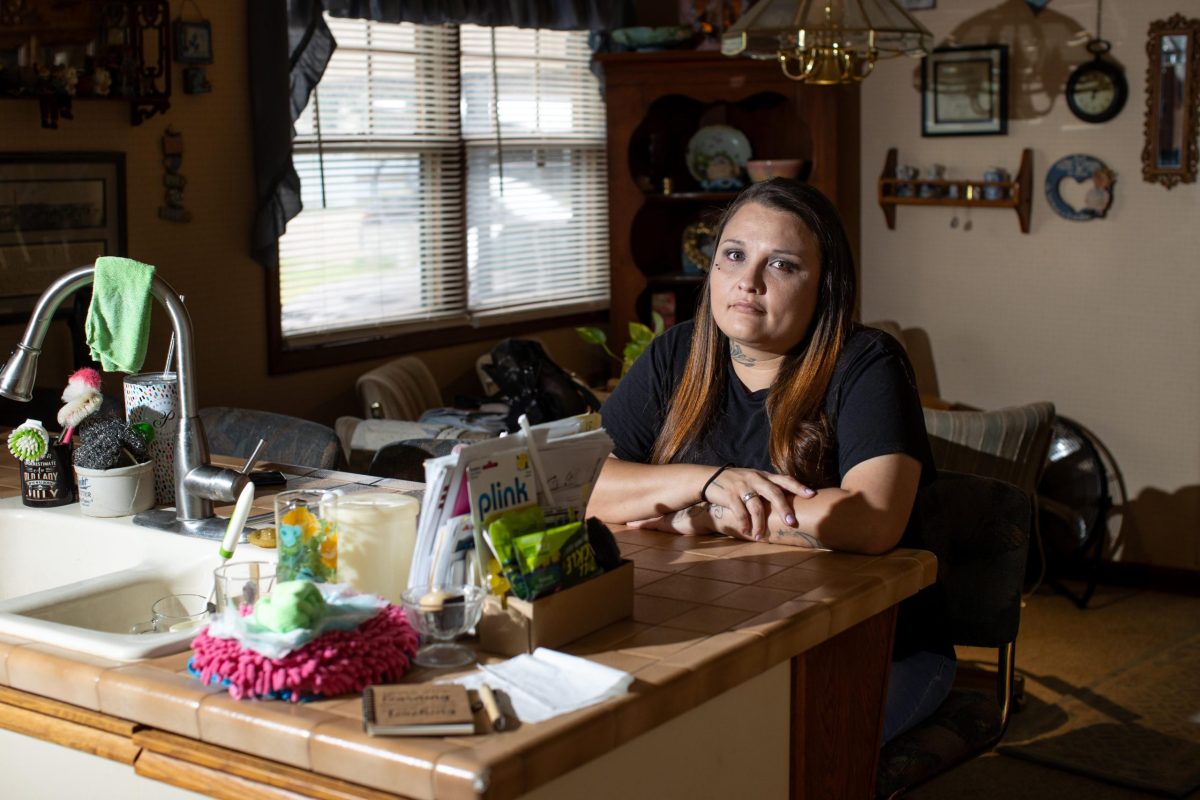

Brittany Sanchez gave birth to her firstborn while shackled to a Guymon hospital bed.
It was April of 2014, and two weeks prior, 22-year-old Sanchez had been arrested in the front yard of her longtime boyfriend, Rafael Alvarado’s house in Elkhart, Kansas, during her baby shower. Her friends and family watched as a young woman, nine months pregnant, was arrested for writing a series of bad checks an hour south, a crime Sanchez said she did not commit.
When her contractions began two weeks later, an officer took her from her Guymon jail cell to Memorial Hospital of Texas County. Sanchez was told that she was on personal recognizance, meaning she was released from custody and on an order to appear at future court dates, yet she remained shackled and monitored by officers outside the door.
She was in labor for twelve hours, with only Alvarado and Sanchez’s grandmother permitted in the room. After delivery, she was given three days with her newborn infant.
Today, Sanchez recalls that when she was discharged, before she was returned to the Texas County jail, she pleaded with her grandmother to be there for the couple’s newborn daughter.
The case against her, which she and a fellow inmate claim was a case of mistaken identity and an attempt by authorities to track down an unrelated suspect, highlights concerns about the familial conflicts of interest and lack of due process that residents say permeate the justice system in the Oklahoma panhandle.
A Case of Mistaken Identity – or Worse
When Sanchez was 18, she cashed a $76 check on behalf of her friend Katie in Elkhart. Katie claimed her aunt was paying her to do chores, Sanchez said. In reality, Katie stole the check without her aunt’s knowledge and set Sanchez up for the fall.

One of Katie’s family members filed charges. For that crime, Sanchez bonded out, took a diversion and paid it off to get the charges dismissed.
Years later, Sanchez’s aunt, Tiffany Sanchez, got wrapped up in a vaguely similar case in Guymon, involving a stolen checkbook at the grocery store.
At the time of the crime, Tiffany was using her mother’s car, a Mountaineer registered to Sanchez’s grandmother’s Elkhart address.
So when Guymon police ran the Kansas plates for the faux checks, they made a call to Morton County and asked what they knew about a ‘Sanchez’.
A Sanchez with a history of checks: Brittany.
Guymon police refused to comment on Sanchez’s case or their protocol for investigating claims of innocence and wrongful arrests.
Sanchez, now 33, sat at her kitchen table, surrounded by antique china and a loyal dog at her heels, recalling painful memories that still haunt her today.
At nine months pregnant, Sanchez sat in the Texas County jail; every day, an officer checked her vitals and gave her a peanut butter sandwich, an apple, and a Gatorade.
Doctor’s appointments were scarce; only one check-in until she went into labor. She recalled her wrist attached to the bed and officers pacing the hallway.
“My mind was so fogged up when this was happening,” Sanchez said. “Because I knew it wasn’t me, and I just could not believe that I was where I was, fixin’ to have my first child.”
Days later, after she handed off her newborn to the father, Sanchez was handcuffed and shackled at the feet, taken back and immediately put into isolation.
“I just sat there,” Sanchez said through tears. “I remember nights I would sit up and just rock. And then there was times I just had to sit there and think. I didn’t know if I was going crazy or what was going on because I just didn’t understand.”
Sanchez said she was put into isolation because a jail official believed her to be depressed and on track to become suicidal.
“I wasn’t depressed when I first went back,” Sanchez said. “I just had my first kid and I was going back [to jail]. So, yes, I was crying. I was upset. I wouldn’t talk to nobody.”
Despite having no prior mental health history, no symptoms of post-partum depression, and no appointments with a physician or psychiatrist, jail officials gave Sanchez drugs: Prozac, an SSRI antidepressant, and the antipsychotic Seroquel, commonly used to treat schizophrenia.
She never saw a doctor.
Signed Statements and an Elusive Video
In the weeks leading up to Sanchez’s delivery, a familiar face showed up: Crystal West, a friend of Sanchez’s mother and aunt. Born and raised in Guymon, West described Sanchez as more like a niece than friend.
After West was booked, she knocked on the wall; she knew from Facebook that Sanchez was pregnant. West asked what she was in there for, and Sanchez shared the sparse details she knew.
“And it took me a minute to click,” West said. “I was like, ‘That wasn’t you. That was me!’”
West described the crime for Sanchez: a group of friends had gotten together while on drugs, including Sanchez’s aunt Tiffany.
“Tiff was too high to leave the house,” West said. “So she had us run down to Guymon Academy School where her son was and drop off some basketball shoes or something.”
West said that she was the one driving and when she got out to drop off the shoes, her friend Zach Lucero got out of the car and snatched a purse he had seen sitting in the vehicle next to them.
“I was like, ‘That wasn’t you. That was me!’”
Crystal West
Later, they stopped by a gas station and then a grocery store. Coincidentally, the grocery cashier was the owner of the stolen purse, and when Lucero tried to cash checks from her book, she called security.
They fled, but witnesses noted the license plates as they drove off.
A few weeks later, officers brought in West on a possession charge, where she wound up in a holding cell adjacent to Sanchez; Lucero was still at large.
Then the pieces all came together: Sanchez was tied to her grandmother’s car.
“[Sanchez] wasn’t even around Guymon at the time, I don’t think,” West said. “And she definitely wasn’t around us.”
West offered to write a statement owning up to the crime. The women pleaded to police, jail personnel, and to then-District Attorney Mike Boring. No one listened.
Detectives also refuted their claims, saying there was video footage of the incident, though no footage was shown at any of their court dates.
Both women told law enforcement to go ahead and check the video, because if there was evidence, it would support their statements. Sanchez has facial piercings on her cheek, and both have unique and distinguishing tattoos on their arms and neck. And while the two women have a similar style of dressing, Sanchez is darker and was nine months pregnant.
Both Sanchez and West gave written statements that went unconsidered. And both women recall being met with responses inferring that West was trying to take the charge for Sanchez.
“That officer could have easily just listened to [West’s] story, and I would have never
had my kid in there,” Sanchez said. “I would have never been in this situation if he would have just took the time to listen, and he didn’t want to listen. He didn’t care. He just brushed us off like we were nothing.”
A Family Matter
A recurring theme in the Justice in No Man’s Land series has been the awkward conflicts of interest that pop up in the panhandle, a place with more cattle than people.
Dozens of panhandle residents have come forward to complain of abuses in the administration of justice in a region that appears to be ruled by family dynasties and generational legacies.
As Sanchez fought her case in 2014, then-DA Mike Boring was celebrating his son Chris taking office in the next county over.
The Oklahoman profiled the pair, chronicling the father-son duo as the first to ever simultaneously hold district attorney positions in Oklahoma, but failed to scrutinize whether a close familial tie in neighboring districts, which together make up nearly all of northwest Oklahoma, might compromise prosecutorial duties.
While the senior Boring has since retired, the history of familial connections left unquestioned across the state has left many panhandle residents feeling they have nowhere to turn.
Sanchez’s story recalls the case of Trena Moser, another Guymon mom who took justice into her own hands, crafting her own motions to defend herself from a system that appeared stacked against her.
Moser and Sanchez had the same prosecutor, the same bondsman, and the same defense. Both stories featured law enforcement operating snitch mills – that is, recruiting and coercing panhandle residents to turn on each other.
Sanchez said the true goal of her arrest was to track down the man police wrongly believed to be the father of her child. They thought they could use an imagined lover as a ploy to reel him in, Sanchez said.
“The DA was convinced that I was pregnant with Zach Lucero’s child,” Sanchez said. “And he wanted to put me on the streets to go find Zach, and I did not know Zach. I didn’t know what Zach looked like. I couldn’t help them.”
Even as Alvarado was recognized as the father of Sanchez’s child, attending the birth and taking the baby home, detectives continued to craft a false narrative, Sanchez said, pushing all court dates off until Lucero was also in custody.
Sanchez met with DA Boring without representation. She sat at a long table, shackled at the ankles and surrounded by a dozen men telling her the plea deal she was gonna take, and how things were going to be.
Sanchez grew up with now Assistant District Attorney Taos Smith, and prior to him becoming the lead prosecutor in his hometown, she recalled him tagging along on father-son bounty hunting trips with Tony Smith, his father and the lone bondsman of Texas County.
The frequency of childhood overlaps and family industries is common in small-town Oklahoma. And even without this deep history, a good relationship is not, in itself, a sign that something is wrong.
However, the Oklahoma Bar Association states it is not a question of actual bias, but rather the appearance of bias, and if there is a prosecutor who appears to engage in representations of the state that are in conflict or that create a personally based conflict of interest.
“It is not a stretch to say that familial relationships have been construed as potentially giving rise to a personally-based conflict of interest,” said Melissa Mortazavi, a professor of legal ethics and professional responsibility at the University of Oklahoma College of Law.
Prosecutors are advised to err on the side of caution. The Oklahoma Bar Association’s Standards of Professionalism sternly advise against any appearance of impropriety or bias.
“It’s not a question of whether or not you actually were biased or you actually did something that you wouldn’t have done otherwise,” said Mortazavi. “The test is, is there a significant risk that the representation of the state is going to be materially limited by the personal interests of the lawyer?”
While Sanchez’s prosecution, stacked with familiar faces, took on a cowboy-style, ad hoc justice, her defense attorney did not offer much reprieve.
Mortazavi characterized an effective attorney to be one who is communicative so that even if the client doesn’t love the outcome, they can at least understand the options and why it turned out that way.
Sanchez did not have this rapport with her assigned Oklahoma Indigent Defense System attorney, Vonda Wilkins.
“I mean, she’s not there for you,” Sanchez said. “She wasn’t there for me. She didn’t try to fight for me, to keep me out of prison.”
The Oklahoma Bar Association requires a prosecutor aware of credible evidence relating to the likelihood that a defendant did not commit a charged offense to immediately disclose and begin remedial measures.
Sanchez maintained her innocence, but described Wilkins as just going with whatever the DA said; she did not feel zealously defended.
West agreed.
“They just tie people to crimes and then put a warrant out for their arrest without even investigating it,” she said.
A Lingering Warrant
Ten years down the road, Sanchez was a mother of three when Texas County came roaring back for her on the same 2014 warrant.
In the years since, she had served some time on unrelated charges.
The 2014 warrant was for the fees relating to her time served in Texas County. She served 13 more months, all stemming from a $76 check and the DA’s awkward attempts to use her in capturing a man she didn’t know.
Sanchez will be paying $100 per month until 2037.
“So I’ve been through a lot,” Sanchez said. “My kid has been through a lot. My 11-year-old asks me questions all the time of why I had her in county, why I had her in jail, why she lives with her meemaw. They just yanked me up out of my kids’ life and sent me to prison for this case.”
Oklahoma Watch reporter JC Hallman contributed to this story.
Editor’s Note: After Oklahoma Watch published an exposé about a multi-million-dollar DA-run ticketing scheme in Texas County, we were flooded with tips from the panhandle. This story is the sixth in a series derived from those tips. The series is available here.

Maria Guinnip was a summer 2025 intern at Oklahoma Watch with support from Columbia University Graduate School and the Institute for Nonprofit News. She is now an Oklahoma-based journalist and Oklahoma Watch contributor. Contact her at mguinnip@oklahomawatch.org.

