


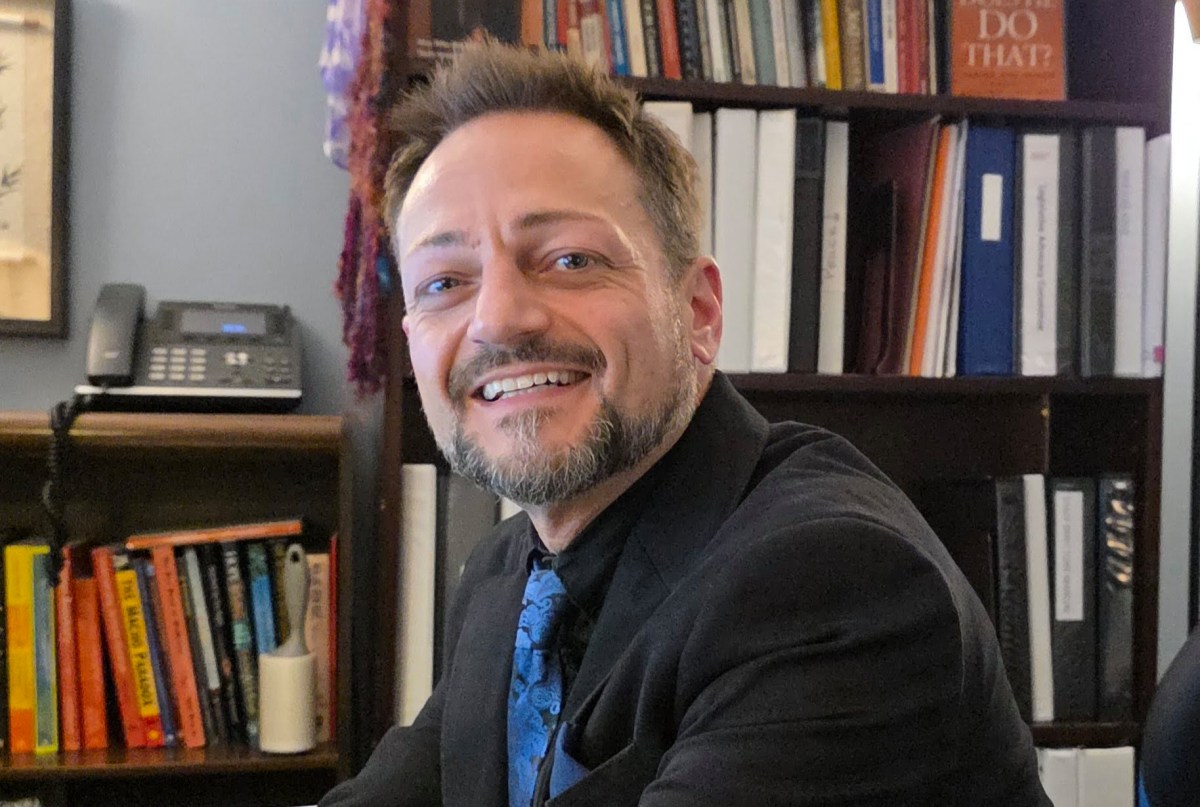

A clash over whether domestic violence victims should be warned that their answers to a life-saving questionnaire could be used against them in court has split Oklahoma’s Fatality Review Board and cost it its chairman.
The board’s vote against the disclosure was a tipping point for the chairman and domestic violence advocate, Brandon Pasley, who resigned shortly after.
“Because I cannot, in good conscience, preside over or participate in a process that sidelines and diminishes victim choice, I must step aside,” he wrote. “Until today, I have been quite proud of, and grateful for, any association I may have had with the Board.”
Pasley served five years on the Domestic Violence Fatality Review Board, a 21-member group of advocates, state agency representatives, lawyers, nurses and law enforcement within the Office of the Attorney General. Their work informs policies to reduce the number of domestic violence-related homicides, which claimed 122 victims in 2023, according to the board’s latest annual report. Oklahoma consistently ranks among the top 10 states for women murdered by men, according to the Violence Policy Center.
State law requires police officers responding to domestic violence calls to assess the danger the victim is in by asking her a series of questions, such as whether the abuser has used a weapon against her or has tried to strangle her. If the assessment triggers enough red flags, the officer is to call a domestic violence hotline on the spot and connect the victim to an advocate.

Studies show the tool, known as a lethality assessment, works. Women are more likely to seek help and implement safety measures.
But the questionnaire isn’t confidential. Her abuser could, at some point, see how she responded. Others, such as prosecutors, judges and even child welfare workers, could too.
Before asking the questions, officers should notify victims that their answers aren’t confidential and are subject to discovery, proposed Jaiden Balthrop-Russell, a lethality assessment coordinator for the attorney general’s office.
That statement can help officers build trust with victims, she told the board Aug. 27. Domestic violence service providers have been asking for it because sometimes the assessment is used against women in failure-to-protect cases, she said.
Another representative of the attorney general’s office, Scott Hawkins, presented the other side. If victims hear the disclosure, it may deter them from cooperating with the officers’ investigation, he said.
“It’s a scare statement,” said Hawkins, a career sheriff’s investigator and the lead lethality assessment coordinator.
Police and prosecutors said victims’ answers to the lethality assessments are valuable to their work — they can help justify a higher bond, for instance, or establish an escalation of violence.
Ultimately, board members rejected the idea of disclosure. A Department of Corrections employee, Nicole Flemming, joined Pasley in support of notifying victims. Eleven others voted against; three abstained.
Pasley said it’s not unusual for advocates and law enforcement to disagree. This one, though, laid bare differences in the fundamental purpose of the lethality assessment protoco, raising the question of whether it’s a tool to help prosecutors or victims.
“As a representative of victim services, I understand it as a tool to connect victims and survivors to those service providers,” he said. “Anything beyond that seems to be a deviation from the model.
“My only recourse to protest was resigning,” Pasley said.
Who is the Tool Serving?
Oklahoma adopted its lethality assessment protocol in 2014 following successful legislation by Kay Floyd, then a state representative and senator-elect, and David Holt, a former senator who is now the mayor of Oklahoma City. Eleven questions, based on the research of Jacquelyn Campbell at Johns Hopkins University, are prescribed in the law as part of the Victim’s Rights Act.
It’s mandatory for officers to ask the questions, but the law doesn’t require victims to participate. Even if she chooses not to answer, officers can trigger the protocol based on their observations at the scene and still make the call to a domestic violence hotline or other advocate.
The intent of the lethality assessment is to spur survivors to take protective action, but shouldn’t be coercive or compromise women’s autonomy, reads a 2016 study of Oklahoma’s lethality assessment program by Campbell and other researchers.
In an interview Wednesday, Campbell said she opposes including a consent statement or nonconfidentiality disclosure and thinks such moves are misguided.
“It unnecessarily complicates things,” Campbell said.
Victims already know, and don’t need to be told, their participation is voluntary, said Laura Thomas, district attorney for Payne and Logan counties. Thomas represents prosecutors on the board. She voted against the proposal and said the board understood the need not to damage the form and make it into a social services bureaucracy.
“To tell them, ‘you don’t have to answer this if you don’t want to,’ it’s ridiculous,” Thomas said. “It’s not safe for the police. It’s not safe for the victim. And it doesn’t help us get anywhere with domestic violence.”
Oklahoma Not Alone
In recent years, 11 states adopted a disclosure as part of their lethality assessment protocol. One of those is Maryland, which serves as a model and now includes the phrase, “this could be used in a court of law.”
Police read suspects their Miranda rights to remind them anything they say can be used against them, Darrell Holly, a program administrator at the Maryland Network Against Domestic Violence, points out when people are skeptical of the need for the disclosure. It makes sense, Holly said, to give the same courtesy to victims completing the form.
He said one of the main concerns has been unfounded: Maryland hasn’t seen significantly different participation rates since adding the statement to the lethality assessment.
“We have to give victims the right and autonomy to make decisions for themselves,” he said. “They understand the situation better than anyone else.”
Jennifer Palmer has been a reporter with Oklahoma Watch since 2016 and covers education. Contact her at (405) 761-0093 or jpalmer@oklahomawatch.org. Follow her on Twitter @jpalmerOKC.
MORE FROM Jennifer Palmer
Isolation, Illness and Guns: Why More Older Oklahomans Are Dying by Suicide
More older Americans are dying by gun suicide. The rate is particularly high in Oklahoma, and especially in rural counties.
OKC Police Are Withholding Reports, Alarming Transparency Advocates
OKC police are withholding police reports unless there was an arrest, charges or a warrant, alarming transparency advocates. The public access counselor sided with police, allowing the practice to continue and, potentially, spread.
No Plans to Distribute Bibles to Public School Classrooms, New Superintendent Says
In a major policy move, Superintendent Lindel Fields said his agency plans to abandon his predecessor’s attempt to buy Bibles for students and wants a lawsuit over it dismissed.

